




News Information

What is the difference between buttons in different countries?
2022-04-19
Buttons are circular pieces with eyelets that are sewn on one side of the garment and pass through the buttonholes on the other side of the garment to fasten the garment. It is a daily clothing item that humans often accompany. According to archaeological findings, as early as 4000 BC, the Persians could make buttons from small processed stones. The ancient Egyptians also made buttons of gold and silver, which were sewn around the collar as an embellishment; the ancient Greeks used buttons and loops on the shoulders to fasten the tunic. However, the decorative function of buttons at this time was greater than the practical value. It was not until the invention of buttonholes in the thirteenth century that the function of buttons was greatly improved. In addition, clothes were generally cut according to the shape of the human body at that time, and the function of buttons became very important. It is important, and the trend of fashion will be difficult to stop. In this way, buttons are also divided into high and low like people's background. The rich and powerful all sew valuable gold, silver or ivory on their clothes. Buttons with their own names to show their wealth and status, and even when they walk into the gate of heaven, they should leave the buttons engraved with their own names as a legacy to future generations. However, the flat-headed people have no such ability. They can only sew the cheapest things from animal bones or wood, and they do not have to think about what to contribute to their brothers and sisters, because they also need wisdom and creativity. The miracles of labor make up for the hardships of life. In the Zhou Dynasty of our country, the system of tops and bottoms has been adopted. Both men and women wear two pieces of clothing with tops and bottoms. The etiquette requirements are also quite strict. There are officials in the court who are in charge of making dresses. Civil and military officials must wear dresses when they are doing ceremonies. At that time, the use of clothing was relatively standardized, and the clothing system was quite complete. In the Zhou Dynasty, the "Zhou Li", "Book of Rites" and other books that reflected the Zhou Dynasty etiquette appeared in the "New" character, "New" is a knot that is intertwined with each other, that is, a knot. According to the copper engraved buttons of the Western Zhou Dynasty in my collection and the archaeological discoveries in my country, buttons were used in the Spring and Autumn Period and the Warring States Period. Among the Warring States cultural relics unearthed in Shizhai Mountain, Jinning, Yunnan, buttons with round, oval, animal head and irregular shapes have been made of orchid, apple green and light gray turquoise. Each has one or two small holes. Some are engraved with patterns, unique in shape, gorgeous and colorful, and have a wonderful waxy luster. In the collection of buttons now collected, there are still simple buttons made of small stones, shellfish, animal horns, walnuts and coconut shells. It can be seen that in the Western Zhou Dynasty, some people already used buttons. In the 14th century, the Chinese brought buttons to Europe, which was an exciting festival for Europeans who were still ragged. At that time, it was an honor and a privilege to be able to tie the undressed robe quite neatly, and the man no longer played with the cloth belt that was not very obedient and disrespectful, and his demeanor also followed. In order to show their wealth, some dignitaries use precious materials such as gold and silver, pearls, gems, diamonds, rhino horn, antelope horn, and ivory to make buttons. Because of the decorations, their attitude became a little arrogant. In France, there is a record that King Louis XIV used 13,000 precious buttons to make a royal robe. Those very beautiful women have few users, and they prefer to sit in the hall to receive friends and relatives after dressing up. At best, the buttons are hung on the waist and play the role of clothing, making it feel that it is just right for my identity. By the 16th century, among noble women, it was popular to sew a large number of buttons as knots and decorations from the elbows to the wrists, and from the neck to the waist. At the beginning of the 18th century, with the establishment of button processing factories in Britain, Germany, France and other countries, buttons with embroidery patterns shined on clothing with design concepts, and tin alloy buttons had replaced other products and became The buttons used by the public and the decoration of copper buttons on military uniforms make the beautiful uniforms shine. In short, during this period, button materials can be described as everything, such as shells, pearls, glass, crystal, leather, buffalo horn, tortoiseshell, bamboo and wood, etc. It is dazzling and less than 50 years have passed. There are cut steel buttons, which are carved with multiple facets on the steel billet, so they are bright, clean,
The Origin of Buttons: The Country of Clothes and Knots
2019-03-14
The development of buttons in China has a peculiar and long history. The earliest button is "rope knot". "rope" is homophonic with "god", and because "rope" is like a curved dragon, its change has thus become the incarnation of god. , "Jie" and "Ji" homophonic, "Ji" has a variety of content, blessing, Lu, longevity, happiness, wealth all belong to the category of Ji. In classical literature, "knot" is more symbolic of the lingering love between men and women. How rich human emotions are, how ever-changing "knot" is. Because of these "knots" as buttons in ancient times, it reflects people's good desire to pursue truth, goodness and beauty and their belief in religion. In terms of form, the ancestors used rope knots to be coiled into an "S" shape to decorate their waists. It has gone through Zhou's "sash belts", the Southern and Northern Dynasties' "double waist belts, and the dream is a concentric knot" to the prosperous Tang Dynasty's "striped silk". Knots, Ning's "Yuhuan Ribbons", and "coil buttons" on cheongsams in Ming and Qing Dynasties. All of them show the status of "knot" in traditional Chinese clothing. After thousands of years of evolution, it was not until modern times that buttons replaced knots. Today, people collectively refer to the ancient "knot" art as "Chinese knot", which has been given a wider decorative role. However, the "knot", a culture that has been handed down for thousands of years, still has a profound impact on modern clothing culture.
2019-03-14
Buttons may have been first seen in the ancient Greeks and Truscans, and were used at the shoulders to fasten tunics with loops. thirteenth century Invented the buttonhole button, a circular piece with eyelets popular in Europe; in the Southern Song Dynasty tomb excavated in Jiangsu Province, China, a round-neck shirt with cloth buttons was found, which proves that China has been around 700 years ago. Cloth buttons. fourteenth century Europeans began to use a large number of buttons on clothing, either practical or decorative; ordinary buttons are made of bone and wood; gold, silver, and ivory buttons are symbols of wealth and class, and copper or alloys are also embedded in ivory, Turtle shells, jewelry. eighteenth century Embroidered cloth buttons are popular, and Chinese cloth buttons are famous for their excellent materials, embroidery craftsmanship, and knotting craftsmanship; copper or tin alloy buttons are popular buttons. mid eighteenth century British use cut steel buttons; French cut steel buttons are engraved with through-hole patterns. early nineteenth century Brass buttons plated with gold are very popular; there are animal horns and plastic-pressed buttons; France is rich in ceramic buttons; Bohemian specialties are colored glass buttons; lacquer-carved buttons are a specialty of China; Production was mechanized and increased. mid nineteenth century South American ivory button made from palm fruit. twentieth century The new button is the mainstream, made of plastic powder or solution by molding; in many ways, the button has been replaced by the zipper. Vintage buttons are collectibles because of their art and craftsmanship. concluding remarks Almost from the day the button originated, people have deposited their living customs, aesthetic tastes, color preferences and cultural mentality in them. I believe that no matter how many years, the inspiration given to buttons will still be the most essential nature.
2019-03-14
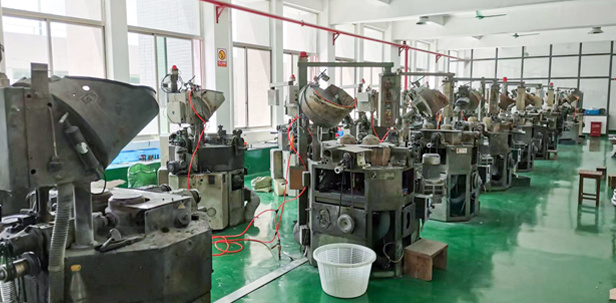
"The company now has a first-class Italian Bonardi button production line. The production technology and process have reached the international leading level, and a complete network system has been formed from research and development to production and sales..."
2019-03-14
“One Button, One Heart”. Every button symbolizes the heart of Shunlong people, the hope for the future and progressive spirit. As “China’s Hometown of Button”, we shoulder the lofty mission of “Develop National Industry”.“The road ahead will be long and our climb will be steep!” Looking into the future, our company will adhere to the tenet of “Survival by Quality, Development by Credit”, ……”
Contact Number:0573-8479920284798807
Address:No. 137 Kaiyuan Avenue, Xitang Town, Jiashan County, Jiaxing City, Zhejiang Province, China
Fax:0573-84798188
Email:webmaster@yinlongcn.com