




News Information

An Enchanted Watery Village Inheriting Thousands Of Year's History
2022-04-19
Civilization is the wealth of human handed down from age to age. The ancient civilization is the value source of modern civilization. It has eternal penetration owing to the communication and continuation on a spiritual level and influences people unconsciously. Looking back into the development history of culture and art, it is not difficult to find that the flourishing dress culture and classic works reflect people’s cultural requirements and the aesthetic ideal of pursuing the true, the good and the beautiful to some extent.
Origin of Button: Garments and Knots
2022-04-19
China has a peculiar and long button development history. The button was known as “Sheng Jie (knot)” at the earliest. “Sheng (rope)” is homophonic with “Shen (deity)”, likes a winding dragon, and becomes the embodiment of deity. “Jie (knot)” is homophonic with “Ji (luck)” which has rich content covering blessing, salary, longevity, happiness and wealth. In classical literature, “Jie (knot)” symbolizes the love of men and women. The rich emotions of human are like the changeful “Jie (knot)”. Therefore, “Sheng Jie (knot)” reflected the good wish of pursuing the true, the good and the beautiful and religious belief in ancient times. The button has developed from S-shaped knot at the waist, the “ribbon” in the Zhou dynasty, “the brocade belt was used to tie a knot at the waist, symbolizing the love of men and women” in the Northern and Southern Dynasties, “silk clothes with ribbon knots” in the flourishing Tang Dynasty, and “the ribbon tied at the waist” to the “button” used by the cheongsam in the Ming and Qing Dynasties, reflecting its position in the Chinese traditional garment. Through thousands of years of evolution, the button replaces “Sheng Jie (knot)” in modern times. Today the ancient “knot” is collectively known as the “Chinese knot” and has a wider range of decorative functions. The “knot” still exerts a far-reaching influence on the modern dress culture.
2022-04-19
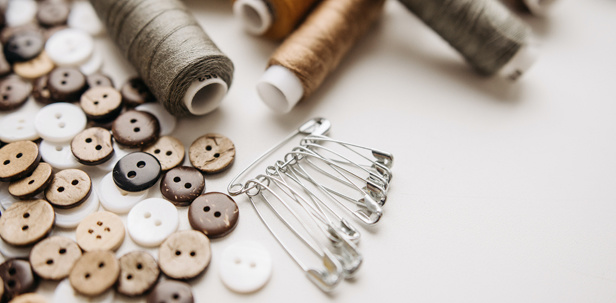
The button can be traced back to the shoulder ring used by the ancient Greek and Etruscans to fasten the tunic. The 13th Century The round flat with holes was popular in Europe. According to the round collar jacket with linen button excavated from the tomb in the Southern Song Dynasty in Jiangsu, it is confirmed that there were linen buttons in China more than 700 years ago. The 14th Century The buttons were used on garment by the European and had practical and decorative functions. The common buttons were made from bone and wood, while the gold, silver and ivory buttons were the symbol of wealth and rank. The copper or alloy was also embedded in the ivory, turtle shell and jewelry. The 18th Century The Chinese embroidery buttons were popular and world-famous owing to the excellent materials, embroidery skills and knotting skills. Meanwhile, the copper and tin alloy buttons were popular with common people. In the Middle 18th Century The polished steel buttons were used in Britain and the engraved steel buttons with through holes were used in France. The Early 19th Century The golden brass buttons were very popular. The horn and plastic buttons were made. There were ceramic buttons in France, the colored glass buttons in Bohemia, and carved lacquer buttons in China. More carved shell buttons were made due to mechanized production. The Middle 19th Century The palm fruit was used to make ivory buttons in South America. The 20th Century The new buttons were mainly solid and were made from plastic powder or solution through mould pressing. The buttons were replaced by zippers in many aspects. The ancient buttons were collected as arts and crafts. Conclusion The button has reflected the life style and customs, aesthetic taste, color culture and cultural mentality since it was made. The inspiration of buttons will still be natural as time goes by.
The Origin of Buttons: The Country of Clothes and Knots
2019-03-14
The development of buttons in China has a peculiar and long history. The earliest button is "rope knot". "rope" is homophonic with "god", and because "rope" is like a curved dragon, its change has thus become the incarnation of god. , "Jie" and "Ji" homophonic, "Ji" has a variety of content, blessing, Lu, longevity, happiness, wealth all belong to the category of Ji. In classical literature, "knot" is more symbolic of the lingering love between men and women. How rich human emotions are, how ever-changing "knot" is. Because of these "knots" as buttons in ancient times, it reflects people's good desire to pursue truth, goodness and beauty and their belief in religion. In terms of form, the ancestors used rope knots to be coiled into an "S" shape to decorate their waists. It has gone through Zhou's "sash belts", the Southern and Northern Dynasties' "double waist belts, and the dream is a concentric knot" to the prosperous Tang Dynasty's "striped silk". Knots, Ning's "Yuhuan Ribbons", and "coil buttons" on cheongsams in Ming and Qing Dynasties. All of them show the status of "knot" in traditional Chinese clothing. After thousands of years of evolution, it was not until modern times that buttons replaced knots. Today, people collectively refer to the ancient "knot" art as "Chinese knot", which has been given a wider decorative role. However, the "knot", a culture that has been handed down for thousands of years, still has a profound impact on modern clothing culture.
2019-03-14
Buttons may have been first seen in the ancient Greeks and Truscans, and were used at the shoulders to fasten tunics with loops. thirteenth century Invented the buttonhole button, a circular piece with eyelets popular in Europe; in the Southern Song Dynasty tomb excavated in Jiangsu Province, China, a round-neck shirt with cloth buttons was found, which proves that China has been around 700 years ago. Cloth buttons. fourteenth century Europeans began to use a large number of buttons on clothing, either practical or decorative; ordinary buttons are made of bone and wood; gold, silver, and ivory buttons are symbols of wealth and class, and copper or alloys are also embedded in ivory, Turtle shells, jewelry. eighteenth century Embroidered cloth buttons are popular, and Chinese cloth buttons are famous for their excellent materials, embroidery craftsmanship, and knotting craftsmanship; copper or tin alloy buttons are popular buttons. mid eighteenth century British use cut steel buttons; French cut steel buttons are engraved with through-hole patterns. early nineteenth century Brass buttons plated with gold are very popular; there are animal horns and plastic-pressed buttons; France is rich in ceramic buttons; Bohemian specialties are colored glass buttons; lacquer-carved buttons are a specialty of China; Production was mechanized and increased. mid nineteenth century South American ivory button made from palm fruit. twentieth century The new button is the mainstream, made of plastic powder or solution by molding; in many ways, the button has been replaced by the zipper. Vintage buttons are collectibles because of their art and craftsmanship. concluding remarks Almost from the day the button originated, people have deposited their living customs, aesthetic tastes, color preferences and cultural mentality in them. I believe that no matter how many years, the inspiration given to buttons will still be the most essential nature.
Contact Number:0573-8479920284798807
Address:No. 137 Kaiyuan Avenue, Xitang Town, Jiashan County, Jiaxing City, Zhejiang Province, China
Fax:0573-84798188
Email:webmaster@yinlongcn.com